
Retomando o nosso artigo
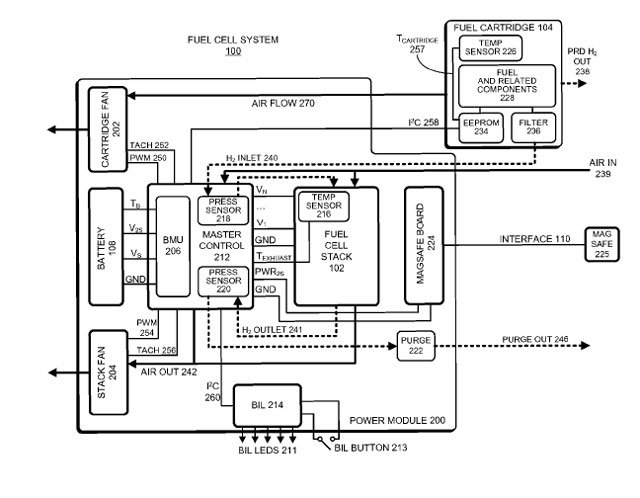
As especificações do futuro iPhone são desconhecidas, mas graças a uma nova patente da Apple, eventualmente poderá vir a ser alimentado por uma bateria de células de hidrogénio.
Esta tecnologia, que não se sabe quanto poderá ser aplicada a pequenas baterias portáteis aumentaria a eficiência e capacidade das actuais baterias de forma exponencial, aguentando-se durante dias antes de necessitar de uma recarga
Dado que a descrição do produto seria extremamente morosa de ser traduzida, deixamos aqui a descrição da patente na sua língua original:
What is claimed is:
1. A fuel cell system which is capable of both providing power to and receiving power from a rechargeable battery in a portable computing device, comprising: a fuel cell stack in the fuel cell system which converts fuel into electrical power; a controller in the fuel cell system which controls operation of the fuel cell system; a power link that transfers electrical power between the fuel cell system and the portable computing device; and a communication link that provides communication between the portable computing device and the controller for the fuel cell system, wherein the controller is configured to regulate both electrical power provided by the fuel cell system to the portable computing device and electrical power provided by the rechargeable battery in the portable computing device to the fuel cell system.
2. The fuel cell system of claim 1, wherein while regulating the electrical power provided by the rechargeable battery in the portable computing device to the fuel cell system, the controller is configured to: monitor an operational parameter of the fuel cell stack during a boot-up process of the fuel cell system; and regulate a discharging current provided by the rechargeable battery to the fuel cell stack based on the value of the operational parameter.
3. The fuel cell system of claim 2, wherein while regulating the discharging current based on the value of the operational parameter, the controller is configured to: determine if the value of the operational parameter is less than a set-point value; and if so, maintain the discharging current provided by the rechargeable battery to the fuel cell stack; otherwise, terminate the discharging current provided by the rechargeable battery to the fuel cell stack.
4. The fuel cell system of claim 1, wherein the fuel cell system does not have an internal rechargeable battery.
5. The fuel cell system of claim 1, wherein while regulating the electrical power provided by the fuel cell system to the portable computing device, the controller is configured to: monitor an operational parameter of the fuel cell stack; and regulate a charging current provided by the fuel cell stack to the portable computing device based on the value of the operational parameter.
6. The fuel cell system of claim 5, wherein while regulating the charging current based on the value of the operational parameter, the controller is configured to communicate with a charging circuit in the portable computing device, wherein the charging circuit is configured to charge the rechargeable battery based on the charging current.
7. The fuel cell system of claim 6, wherein while regulating the charging current based on the value of the operational parameter, the controller is configured to: determine whether the value of the operational parameter is greater than or smaller than a set-point value; if the value of the operational parameter is greater than the set-point value, regulate the charging current so that the value of the operational parameter decreases; and if the value of the operational parameter is smaller than the set-point value, regulate the charging current so that the value of the operational parameter increases.
8. The fuel cell system of claim 7, wherein if the value of the operational parameter is greater than the set-point value, the controller is further configured to continue regulating the charging current until the value of the operational parameter decreases to the set-point value; and wherein if the value of the operational parameter is smaller than the set-point value, the controller is further configured to continue regulating the charging current until the value of the operational parameter increases to the set-point value.
9. The fuel cell system of claim 7, wherein if the value of the operational parameter is substantially equal to the set-point value, the controller is configured to maintain the charging current so that the value of the operational parameter remains the same.
10. The fuel cell system of claim 7, wherein while regulating the charging current to decrease the value of the operational parameter, the controller is configured to transmit a first control signal to the charging circuit in the portable computing device, wherein the first control signal causes the charging circuit to increase the charging speed for the rechargeable battery, which subsequently causes the charging current to increase and the value of the operational parameter to decrease; and wherein while regulating the charging current to increase the value of the operational parameter, the controller is configured to transmit a second control signal to the charging circuit in the portable computing device, wherein the second control signal causes the charging circuit to decrease the charging speed for the rechargeable battery, which subsequently causes the charging current to decrease and the value of the operational parameter to increase.
11. The fuel cell system of claim 10, wherein the controller transmits the first and the second control signals through the communication link.
12. The fuel cell system of claim 5, wherein the controller routes the charging current through the power link.
13. The fuel cell system of claim 6, wherein the charging circuit is configured to convert the charging current into a charging voltage suitable for charging the rechargeable battery.
14. A method for operating a fuel cell system coupled to a portable computing device, wherein the fuel cell system is capable of both providing an electrical power to and receiving an electrical power from a rechargeable battery in the portable computing device, the method comprising: regulating the electrical power provided by a fuel cell stack in the fuel cell system to the rechargeable battery in the portable computing device and regulating the electrical power provided by the rechargeable battery in the portable computing device to the fuel cell system through: a power link that transfers electrical power between the fuel cell system and the portable computing device; and a communication link that provides communication between the portable computing device and the controller for the fuel cell system.
15. The method of claim 14, wherein regulating the electrical power provided by the rechargeable battery to the fuel cell system involves: monitoring an operational parameter of the fuel cell stack during a boot-up process of the fuel cell system; and regulating a discharging current provided by the rechargeable battery to the fuel cell stack based on the value of the operational parameter.
16. The method of claim 15, wherein regulating the discharging current based on the value of the operational parameter involves: determining if the value of the operational parameter is less than a set-point value; and if so, maintaining the discharging current provided by the rechargeable battery to the fuel cell stack; otherwise, terminating the discharging current provided by the rechargeable battery to the fuel cell stack.
17. The method of claim 14, wherein the fuel cell system does not have an internal rechargeable battery.
18. The method of claim 14, wherein regulating the electrical power provided by the fuel cell stack in the fuel cell system to the rechargeable battery in the portable computing device involves: monitoring an operational parameter of the fuel cell stack; and regulating a charging current provided by the fuel cell stack to the portable computing device based on the value of the operational parameter.
19. The method of claim 18, wherein regulating the charging current based on the value of the operational parameter involves communicating with a charging circuit in the portable computing device, wherein the charging circuit is configured to charge the rechargeable battery based on the charging current.
20. The method of claim 19, wherein regulating the charging current based on the value of the operational parameter involves: determining whether the value of the operational parameter is greater than or smaller than a set-point value; if the value of the operational parameter is greater than the set-point value, regulating the charging current so that the value of the operational parameter decreases; and if the value of the operational parameter is smaller than the set-point value, regulating the charging current so that the value of the operational parameter increases.
21. The method of claim 20, wherein regulating the charging current to decrease the value of the operational parameter involves continuing regulating the charging current until the value of the operational parameter decreases to the set-point value; and wherein regulating the charging current to increase the value of the operational parameter involves continuing regulating the charging current until the value of the operational parameter increases to the set-point value.
22. The method of claim 20, wherein if the value of the operational parameter is substantially equal to the set-point value, the method further comprises maintaining the charging current so that the value of the operational parameter remains the same.
23. The method of claim 20, wherein regulating the charging current to decrease the value of the operational parameter involves transmitting a first control signal to the charging circuit in the portable computing device, wherein the control signal causes the charging circuit to increase the charging speed for the rechargeable battery, which subsequently causes the charging current to increase and the value of the operational parameter to decrease; and wherein regulating the charging current to increase the value of the operational parameter involves transmitting a second control signal to the charging circuit in the portable computing device, wherein the control signal causes the charging circuit to decrease the charging speed for the rechargeable battery, which subsequently causes the charging current to decrease and the value of the operational parameter to increase.
24. The method of claim 23, wherein the method further comprises transmitting the first and the second control signals through the communication link.
25. The method of claim 20, wherein the method further comprises routing the charging current through the power link.
26. A portable computing device that is capable of both providing power to and receiving power from a fuel cell system, comprising: a processor; a memory; a rechargeable battery; a power link that transfers electrical power between the fuel cell system and the portable computing device; and a communication link that provides communication between the fuel cell system and the portable computing device, wherein the portable computing device is configured to adjust an operational parameter of the fuel cell system through the power link and the communication link.
27. A portable computing device that receives power from and controls operation of a portable fuel cell system, comprising: a processor; a memory; a power link that transfers electrical power between the portable fuel cell system and the portable computing device; and a communication link that provides communication between the portable fuel cell system and the portable computing device; wherein the portable computing device is configured to control operation of the portable fuel cell system through the power link and the communication link.
28. The portable computing device of claim 27, further comprising: a rechargeable battery within the portable computing device to provide power to the portable computing device; wherein the rechargeable battery is additionally configured to supply power to operate the portable fuel cell system, wherein the power is supplied through the power link.
29. A portable fuel cell system which is controlled by a portable computing device, comprising: a fuel cell stack which converts fuel into electrical power; a power link that transfers electrical power between the portable fuel cell system and the portable computing device; and a communication link that provides communication between the portable computing device and the portable fuel cell system; wherein the portable fuel cell system is configured to provide information to and receive commands from the portable computing device to control operation of the portable fuel cell system.
30. The portable fuel cell system of claim 29, wherein the portable computing device includes a rechargeable battery; and wherein the portable fuel cell system is configured to receive power from the rechargeable battery in the portable computing device to operate the portable fuel cell system, wherein the power is received through the power link.


 ———- Siga-nos no facebook ———-
 ————- Siga o nosso feed ————-
 ————- Siga-nos no twitter ————-

Últimos Comentários